Student Hub
A public wall for student voice — and a route to a response.
01 / Context
Student feedback often disappears into private chats or a single suggestion box. The people who can act never see the pattern; the people who spoke never see what happened.
The gap is not only technical. It is a design problem: how do you make a voice public without exposing the person who spoke? How do you give a complaint a route without promising a result you cannot control?
02 / What I did
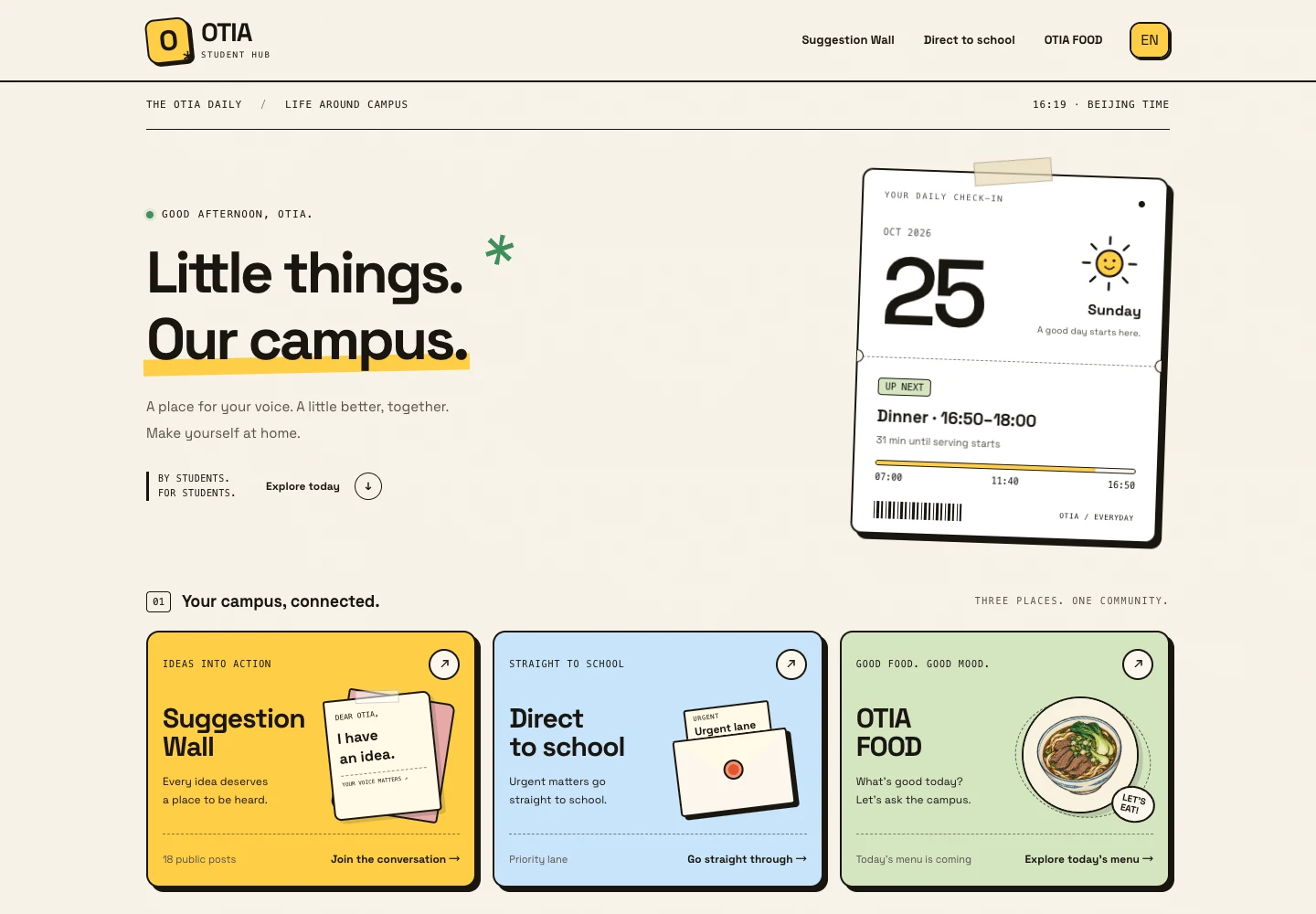
I built and iterated a student hub around three surfaces: a public wall, a direct-to-school channel, and daily campus information.
The wall is public and anonymous to students; identity is verified in the back end. The direct channel gives a pattern somewhere to go. The daily surface gives students a reason to return when they do not have a complaint.
03 / The loop
The current build is organized as a loop: speak → see → route → respond.
Each step has a different design problem. Speaking needs safety. Seeing needs a public surface. Routing needs an owner. Responding needs a visible change, not just a reply.
A thought, a complaint, or a small idea.
The wall makes the pattern public.
The direct channel gives it a route.
04 / What changed
The current build is organized as a loop. The question is no longer only “how do we collect feedback?” but “what happens after someone speaks?”
I am keeping the public page free of adoption numbers until there is a verified way to describe them. The design is the evidence here; the outcome is still being documented.
05 / What I’m asking now
How do you design for trust when the institution holds more power than the student? How do you keep a public wall from becoming a performance of complaint?
If you work on student voice, participation, or institutional design, I would like to compare notes. Say hello.